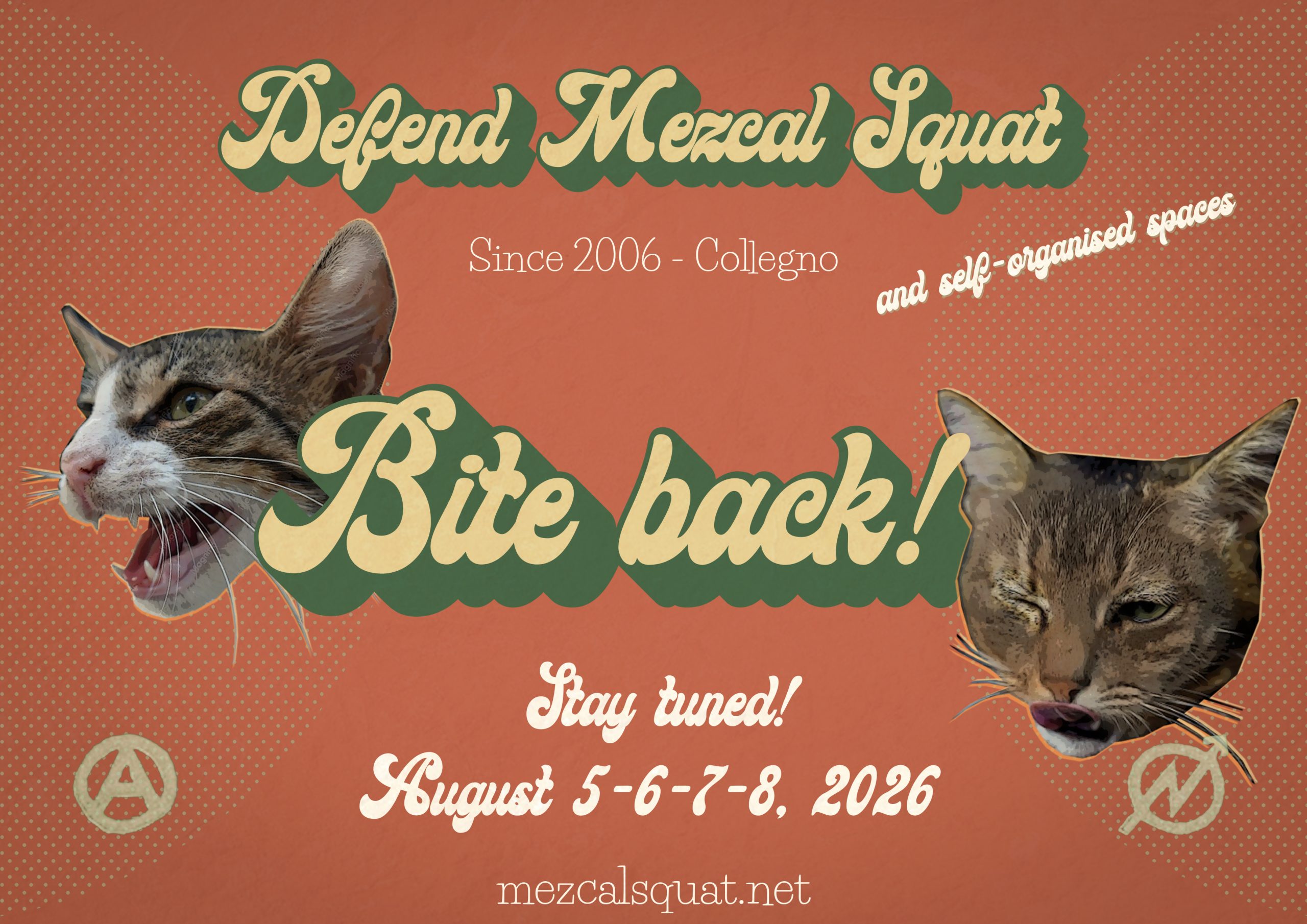
One month to go until the celebrations marking 20 years of the Mezcal occupation, and—as has been attempted in the past—a new project is underway to “secure” Pavilion 21.
Built in 1910 as the Criminal Ward of Collegno’s Mental Asylum and abandoned in the late 1980s, Pavilion 21 was occupied in 2006 by a group of young people who had come together in Turin Squats of those years.
Twenty years ago, the people who entered the building found a human dump, left overs of lives on the margins: syringes, pools of blood, feces; suffering had not left those walls even after the Basaglia Law. It took a great deal of work to clean up and set up the place, and when you walk into Mezcal today, you’ll find many spaces—a rehearsal room, a gym, a workshop, a woodshop, a screen-printing studio, and multipurpose areas—all open to the community.
To occupy means opening up an otherwise unused space and committing to creating, through one’s own efforts, a place where political activities can take place and where social interaction can be experienced without the mediation of profit.
Activities at Mezcal are carried out without money and on a self-managed basis. This approach—which we ironically call “Bellavita”—consists of sharing experiences and knowledges, learning to collaborate to solve problems and carry out projects collectively, without hierarchies.
Turin and Piedmont have a long history of occupied and self-managed social spaces. From the 1980s to the present, administrators of every political stripe have lashed out against these occupations, labeling them as emergencies—whether health, safety, or public order—the perfect ploy to avoid addressing other real emergencies for which they are directly responsible. Joining this well-established system of distraction, in the case of Mezcal, is also the ASL TO3—led since 2025 by Giovanni La Valle.
The Director is a figure with an extensive resume, difficult to summarize in a few words: from 2016 to the present, he has left behind many suspicious transactions related to the assignment of key positions and roles within the healthcare system.
Particularly notable is his work as director of Città della Salute Torino—from 2018 to 2025—which was so “impressive” that it led to his being named among the defendants in the trial concerning the falsified financial statements that contributed to the economic collapse of the healthcare complex. Almost a year after he left the directorship, Molinette Hospital is “celebrating” with the collapse of a drop ceiling in the Neurosurgery ward and waiting lists for patients stretching on and on.
How is it possible that such a person ended up at the helm of the largest healthcare hub and the largest local health authority in Piedmont? After all, the other activity that stands out in La Valle’s resume is his political connections: dinner’s meeting with Salvatore Gallo (PD), convicted of embezzlement and corruption related to the TAV( high-speed rail project ) and the healthcare system, regurarly attending the events organized by Fabrizio Ricca’s Lega and, most recently, has aligned himself with Maurizio Marrone—a former FUAN militant and, until recently, an activist involved in the far-right OSA Lingotto occupation—and Alberto Romeo (FdI).
Given the current state of healthcare and essential services in the region, the only certainty we can expect from these security professionals—whether in healthcare or public safety—is that they will abandon us.
In the long history of occupations—both housing and political—that has marked Turin and its surroundings, very few buildings have been brought back to life after eviction: the sad reality of “extraordinary operations” carried out in the name of “security” is that the buildings remain boarded up and abandoned. Pavilion 21 was an abandoned building and risks becoming so again, as there are no projects or investors on the horizon.
From 2019 to the present, more than a dozen social spaces have been evicted in Turin and its surrounding areas: a desperate attempt by those few incompetent individuals, sitting in the right chairs, to remain relevant. By carrying out evictions, they try to prove they’re doing something—besides wasting a lot of public resources. In a world ravaged by wars and climate change, with a dying society that offers loneliness and social fragmentation… Squatting is not the real emergency!